May 2016

How much has our economic wellbeing improved from that our of distant ancestors?

A view of economic progress. Ponder the productivity improvement and resulting increase in wealth to go from this:

Image courtesy of DollarPhotoClub.com

To this:

Image courtesy of Adobe Stock.

The overall standard of living has increased by a factor of somewhere between 30 and 100 in the last 200 years.

The little side trip in this post and the next will lead me back to my discussion of ancient finances in general and Alexander’s haul from his military campaigns in particular.

Writing in Bourgeois Equality: How Ideas, Not Capital or Institutions, Enriched the World, Professor Deirdre McCloskey says it this way:

..in the two centuries after 1800 the trade-tested goods and services available to the average person in Sweden or Taiwan rose by a factor of 30 or 100. Not 100 percent, understand— a mere doubling— but in its highest estimate a factor of 100, nearly 10,000 percent, and at least a factor of 30, or 2,900 percent. The Great Enrichment of the past two centuries has dwarfed any of the previous and temporary enrichments.

Let me phrase that another way. The value of what is enjoyed today by an average person is roughly equal to what 30 or 100 people had two centuries ago. That means the constant dollar value of what is consumed and enjoyed has grown by a factor of somewhere between 30 and 100.

How much has our economic wellbeing improved from that our of distant ancestors? Read More »

To all those serving in the American military or who have served

Image courtesy Adobe Stock.

I was on active duty in the U.S. Air Force a mere four years. I never got within 3,000 miles of hostile action against American forces. To top it off, my small contribution was decades ago.

As a result, I am squeamishly uncomfortable accepting the appreciation when someone tells me “Thanks for your service.”

It took me a few years to get to a place where I could accept those comments.

I now graciously and proudly accept those expressions of appreciation from my fellow Americans, not because of what I did so long ago, but on behalf of all those soldiers, sailors, marines, and airmen who do not have someone looking them in the eye, shaking their hand, and saying “thanks.”

So for all those troops pulling alerts, standing watch, scheduling logistics, or taking fire, please know that vast numbers of Americans are grateful for your service.

I pass on to you their thanks.

You are there, not here, so many people have thanked me instead. It is you they are really thanking.

While today we remember with gratitude those who did not return, I hope those who are serving today hear the appreciation.

To all those serving in the American military or who have served Read More »

Overview of new lease accounting rules

Image courtesy of DollarPhotoClub.com before they merged into Adobe Stock.

In about three years there will be a complete overhaul of the accounting rules for leases.

For a quick introduction to the changes, here are a few of the comments in a recent AICPA webinar.  I will keep this nontechnical.

(Discussion cross-posted from my other blog, Nonprofit Update, because this discussion will be a good intro for CPAs.)

“Right of use” asset

The basic concept is that a lease contract gives you the right to control the use of property, equipment, office space, or some other identified asset for a specific period of time. The economic substance is that the asset is yours to use for the term of the lease.

By creating a “right of use”, the lease contract gives you an asset that needs to be reflected on the balance sheet. In addition the liability for future payments needs to be recognized.

Overview of new lease accounting rules Read More »

That pesky problem of actually having to prove in court that banks committed fraud and actually having the case survive on appeal

Image courtesy of Adobe Stock

A hurdle that keeps popping up when the U.S. or other governments take a banker to trial is being able to prove the case in court. Now the pesky issue is surfacing of having a case survive on appeal.

5/23 – Wall Street Journal – Bank of America Penalty Thrown Out in Crisis-Era “Hustle” Case / Appeals court says government didn’t prove case, bank doesn’t have to pay $1.27 billion – The ongoing challenge of all the allegations of bad behavior in the banking world before the Great Recession continues to face the little bitty problem of actually proving cases in court.

Take a look at the latest collapse of a government case.

That pesky problem of actually having to prove in court that banks committed fraud and actually having the case survive on appeal Read More »

Updates on banking fiascos

Image courtesy of DollarPhotoClub.com

A few articles that have caught my eye on varied aspects of the overall range of banking fiascos in play:

4/14 – New York Times – How Regulators Mess With Bankers’ Minds, and Why That’s Good News the previous week was that many of the huge banks failed their ‘living will’ test. Each bank that is labeled as having ‘systemic risk’ must submit for approval a plan on how they would wind down in the event of failure. The purpose is to show they would not take down the entire financial system.

This article points out the banks were not told what their living will should contain or what it should look like.

As an expected result, likely intentional, the banks’ plans failed the test. When you don’t know how the test will be scored, or even what will be on the test, you are unlikely to pass. Sort of like having to turn in a term paper without know what topic the professor will select.

Again, this article thinks it is wonderful that the banks are evaluated on criteria that are not disclosed to them.

Updates on banking fiascos Read More »

Alexander’s haul from looting Susa, the capital of Persia. Revised estimate of value of one Athenian Talent

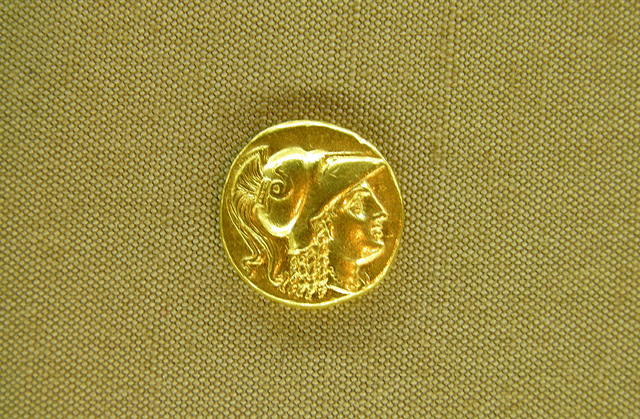
Greek silver tetradrachm from Alexander the Great showing Hercules wearing lion skin at obverse and Zeus at reverse, dated 323-315 BC. Image courtesy Adobe Stock.
Greek silver tetradrachm from Alexander the Great’s timeframe, showing Hercules wearing lion skin at obverse and Zeus at reverse, dated 323-315 BC.  A tetradrachm is equal to four drachma. Image courtesy Adobe Stock.

Update:  I have revised my calculations here. Adjusted the value of an Athenian talent from 10 years salary today up to 400 years salary due to the dramatic improvement in our wealth and standard of living in the last 200 years (the Great Betterment). Also adjusted from estimated average wage in the U.S. of $20 an hour to average wage for skilled construction worker of $70,000 per year. That takes the rough valuation from $20 billion to $1,400 billion, or $1.4 trillion. That actually seems to make sense in a very rough way.

Continuing my discussion of a few tidbits of financial information from Alexander the Great’s military campaigns.

When Alexander approached Susa, the capital of Persia, news of his non-stop victories preceded him. Previous cities he captured surrendered before he arrived. That typically spared most citizens their lives and prevented the torching of the city.

Thus, Susa was handed to him without a fuss, except for a huge amount that Darius III carted off well in advance of Alexander’s arrival.

The author looks at the various reports of how much loot was acquired. Integrating the report that is likely to be most reliable with the other reports results in an estimate Alexander capturing a haul of 40,000 talents of uncoined bullion and about 10,000 talents of gold coin. The gold is roughly valued by expressing the amount what it would be in silver value.

Apparently the Persians didn’t cast most of their precious metals into coins, instead preferring to mint what they needed as they needed it.

Revised value of a talent

Multiple changes have shifted the relative value of gold and silver in relation to each other and in relation to their purchasing power. Instead of converting a talent of silver into ounces and converting that to current dollars at current exchange rates, I’ll start looking at piles of money in terms of average days wages.

Warning: I plan to update my valuation of a Talent based on the radical improvement in living standards that has developed since the Industrial Revolution.

Alexander’s haul from looting Susa, the capital of Persia. Revised estimate of value of one Athenian Talent Read More »

Value of 1 ancient Greek drachma and 1 Athenian Talent

Image: Flickr by Carole Raddato

Image: Courtesy of Flickr by Carole Raddato

If you are curious and want to follow along, I’ll be spending a bit of time looking at some details of ancient finance.

If you are already somewhat familiar, feel free to either roll your eyes as I flounder along or chuckle on how slow I am to catch on. If your knowledge of ancient finances is comparable to mine, that is to say approximately zero, please feel free to join me on a journey to learn a few details.

Wikipedia has some information about the Greek drachma which seems plausible. Will also mention some comment by Prof. Holt.

Comparable value

Article in Wikipedia says some economists and historians say one drachma in the 5th century (let me do a mental calculation – – that would be from about 499BC to 401BC) was about US$25 in 1990 or US$46.50 in 2015.

Classical historians give a different read for the 5th and 4th centuries (okay, mental math time, so that would be from around 499BC to 301BC, the 400s and 300s). In that time, one drachma would be around one days wages for a skilled worker or a hoplite. So that would not be minimum wage, but more along the line of a carpenter or mason.

Value of 1 ancient Greek drachma and 1 Athenian Talent Read More »

One framework for the ideal CPA trade association – Implications for the proposed AICPA-CIMA merger

 Image courtesy of DollarPhotoClub.com
Image courtesy of DollarPhotoClub.com

Professors Paul Miller and Paul Bahnson writing at Accounting Today describe their ideal professional association – and why the AICPA doesn’t measure up.

Use their framework to assess the proposed merger of the AICPA and CIMA.

My previous comments on the merger:  On that merger of the AICPA and the CIMA resulting in a new AICPA.

The professors suggest the following premises for what a trade association would look like if the goal was to advance the profession and the interest of its members. I will quote their comments:

One framework for the ideal CPA trade association – Implications for the proposed AICPA-CIMA merger Read More »

Update on Panama Papers – 5/9

Image courtesy of DollarPhotoClub.com

The story is getting more confusing:

  • new revelation of an old technique to launder money,
  • US government actions to reduce laundering that look to me like they are just eyewash, and
  • small investors in a local real estate project appear to be investors working through the Panamanian system.

5/5 – Star-Telegram – Panama law firm used charities’ names as cloaks for clients – One of the schemes used in hiding money through offshore companies is setting up a foundation under Panamanian law. A private foundation can be set up which requires three directors, two of which must be publicly disclosed. Intended beneficiaries must be identified but could be changed before any funds disbursed.

The way this works is the two named individuals work for the law firm while the third undisclosed person is the person hiding money. The undisclosed person calls the shots with the two staff people from the law firm following instructions. The beneficiaries can be changed at any time.

Update on Panama Papers – 5/9 Read More »